About the Journal

Passagens Journal is a publication of the Graduate Program in Communication of the Federal University of Ceará (PPGCOM/UFC). The purpose of the journal is to discuss the meaning of communicative practices both in the professional field and in research, in order to promote and disseminate scientific and technical knowledge in the field.

Announcements

Current Issue

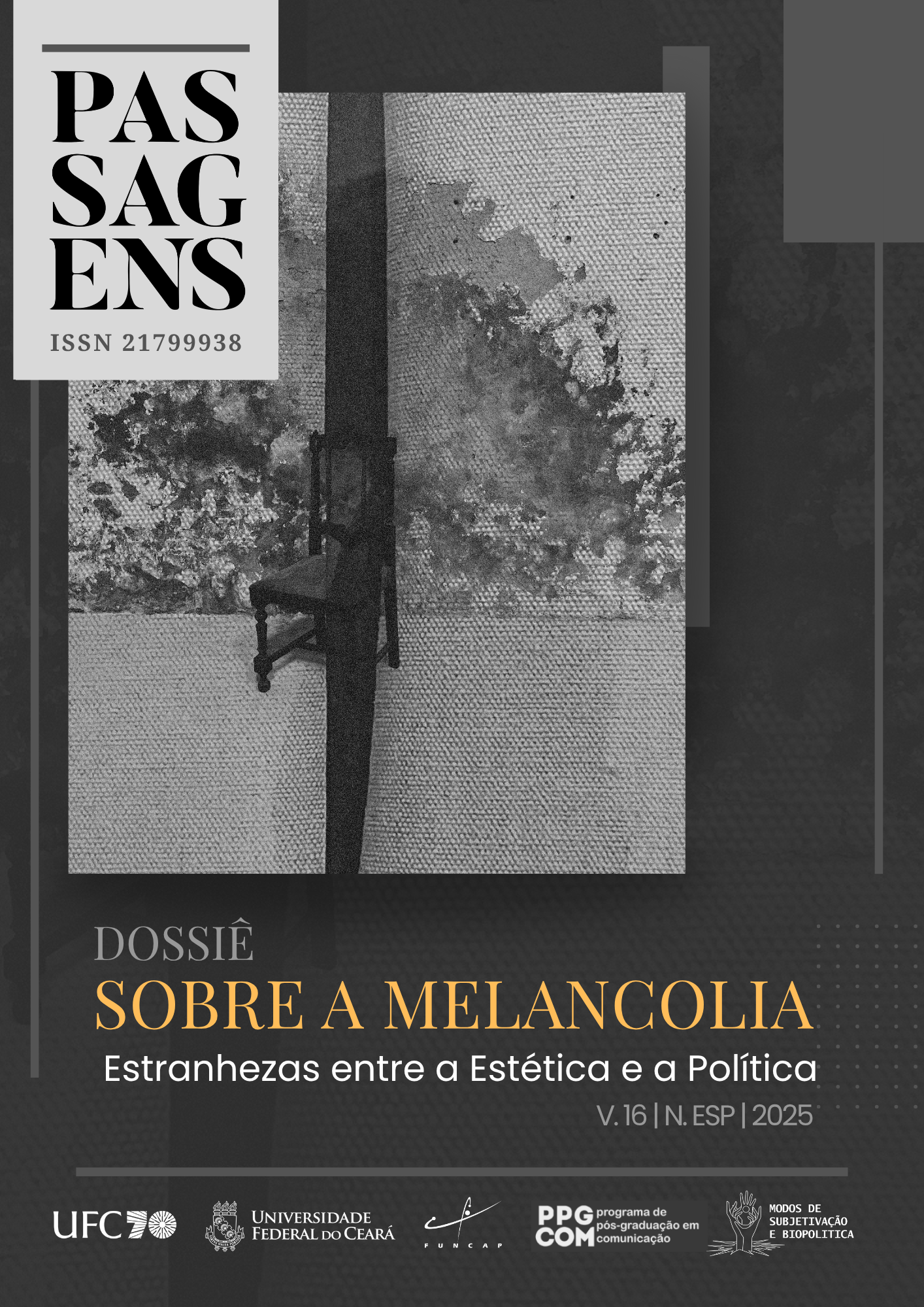
Vol. 16 No. 1 (2025): Dossiê Sobre a Melancolia: Estranhezas entre a Estética e a Política
					View Vol. 16 No. 1 (2025): Dossiê Sobre a Melancolia: Estranhezas entre a Estética e a Política
Published: 2025-11-07

Editorial

  • Editorial Dossier Melancholy: oddities between aesthetics and politics

    Regiane Lorenzetti Collares, Luis Celestino de França Júnior, Fabio Parode
    4-6
    DOI: https://doi.org/10.36517/psg.v16i1.96241

Dossiê "Sobre a Melancolia. Estranhezas entre a Estética e a Política"

  • Melancholy and capitalism

    Leda Mendes Gimbo, Fernando Gimbo
    7-23
    DOI: https://doi.org/10.36517/psg.v16i1.96242
  • Melancholic gender writings in Judith Butler and Édouard Louis

    Regiane Lorenzetti Collares, Luis Celestino de França Júnior
    24-43
    DOI: https://doi.org/10.36517/psg.v16i1.96243
  • Melancholic and nostalgic atmospheres: clouds and mists of longing in “Tabu”, by Miguel Gomes

    Renato Souto Maior
    44-63
    DOI: https://doi.org/10.36517/psg.v16i1.96075
  • Can a pop diva be melancholic? The brazilian fans' imaginary about Adele, her songs and melancholic

    Guilherme Alves, Adriana da Rosa Amaral
    64-83
    DOI: https://doi.org/10.36517/psg.v16i1.96073
  • Melancholy and fear of feminine in The devil's bath

    Ana Maria Acker, Muriel Rodrigues de Freitas
    84-111
    DOI: https://doi.org/10.36517/psg.v16i1.96245
  • Inadequacy, isolation and melancholy: young people in brazilian films during the development of bolsonarism

    Daniel Feix
    112-132
    DOI: https://doi.org/10.36517/psg.v16i1.96074
  • Melancholy gender and its effects: abjection, crystallization and violence in the film El lugar sin límites

    Felipe de Britto Maiello, Icaro Ferraz Vidal Junior
    133-151
    DOI: https://doi.org/10.36517/psg.v16i1.96082
  • Melancholy in the Consolation of Marcia: Stoic perspectives and philosophical updates

    Vilmar Prata
    152-166
    DOI: https://doi.org/10.36517/psg.v16i1.96251
  • Remembering, repeating and working-through: the trauma of dictatorship in Tony Manero and I'm still here

    Pedro Rocha de Oliveira
    167-178
    DOI: https://doi.org/10.36517/psg.v16i1.95930
  • Melancholy and discomfort in A Gis: archives of Gisberta Salce's memory

    Luís Fellipe dos Santos
    179-193
    DOI: https://doi.org/10.36517/psg.v16i1.96110
  • The artist's saudade: depathologizing melancholy

    Ricardo Rigaud Salmito, Luisa Teixeira Salmito
    194-212
    DOI: https://doi.org/10.36517/psg.v16i1.96083
  • BDSM in the work of Leonilson

    Ribamar José de Oliveira Junior
    213-224
    DOI: https://doi.org/10.36517/psg.v16i1.95909
  • What does the game Disco Elysium have to say about left-wing melancholy?

    Matheus Rodrigues
    225-250
    DOI: https://doi.org/10.36517/psg.v16i1.95697
  • Immortal melancholy: technology, society and time in Interview with the vampire (1994)

    Isabella Gaeta, Laura Loguercio Canepa
    251-267
    DOI: https://doi.org/10.36517/psg.v16i1.95782
  • The image and the unrepresentable: mourning as aesthetic dissensuality in the work of Cândido Portinari

    Francielle Czarneski
    268-285
    DOI: https://doi.org/10.36517/psg.v16i1.95826
View All Issues